
Most organisations understand the importance of patching to reduce or eliminate vulnerabilities across their network. For mainstream platforms such as Microsoft Windows, Linux distributions, and common productivity applications, the process is well‑supported. Tools like Qualys can identify vulnerabilities, and platforms such as SCCM or WSUS can automate patch deployment with minimal disruption. But this only solves half the problem. A significant portion of operational risk now sits outside the standard patching ecosystem — in the third‑party applications and middleware layers that underpin mission‑critical business systems. These components often include technologies such as Java, Apache, Tomcat, WebLogic, WebSphere, OpenSSL, and vendor‑supplied runtimes. They are essential, deeply embedded, and notoriously sensitive to change.
The Hidden Challenge of Non‑Standard Vulnerabilities
Unlike operating systems, middleware and third‑party application stacks rarely support automated patching. Even when patches exist, applying them can introduce serious risks:
Updating Java, Tomcat, or other middleware can break the application that depends on it
Some applications are only certified against specific middleware versions
Certain updates introduce licensing or support implications
Legacy or bespoke systems often cannot tolerate downtime or unexpected behaviour Because of these constraints, organisations frequently delay or avoid patching these components — even when vulnerabilities are severe.
The Testing Burden
Patching middleware isn’t just a technical task; it’s a full operational cycle:
Build or refresh a test environment
Apply patches to middleware and supporting components
Execute functional and regression testing
Validate integrations and data flows
Coordinate with vendors or internal development teams
Plan and schedule production deployment For environments with dozens or hundreds of affected servers, the workload becomes overwhelming. It’s not unusual for a single Qualys scan to identify thousands of vulnerabilities across middleware and third‑party applications.
From Scan Report to Actionable Plan
Qualys reports are excellent at identifying vulnerabilities, but they don’t tell you:
which servers can be patched immediately
which require testing
which need vendor approval
which have licensing constraints
which require alternative mitigation strategies
how to prioritise remediation across hundreds of systems Turning a raw vulnerability report into a server‑by‑server remediation strategy is the real challenge. It requires technical understanding of middleware, awareness of application dependencies, and the ability to balance risk, downtime, and operational impact.
Our Approach
Our processes are designed specifically for these non‑standard, high‑risk environments. We take you from a Qualys report to a structured, prioritised, and test‑ready remediation plan in a fraction of the time normally required. The output includes:
A tailored remediation strategy for each server (Fig. 1)
A customisable management dashboard to track progress, risk reduction, and operational impact (Fig. 2)
Clear decision paths for patching, upgrading, isolating, or mitigating vulnerabilities
Support for middleware‑specific constraints, including version compatibility and vendor certification This approach transforms vulnerability management from a reactive, manual burden into a predictable, controlled, and measurable process — even for the most complex third‑party and middleware‑driven environments.
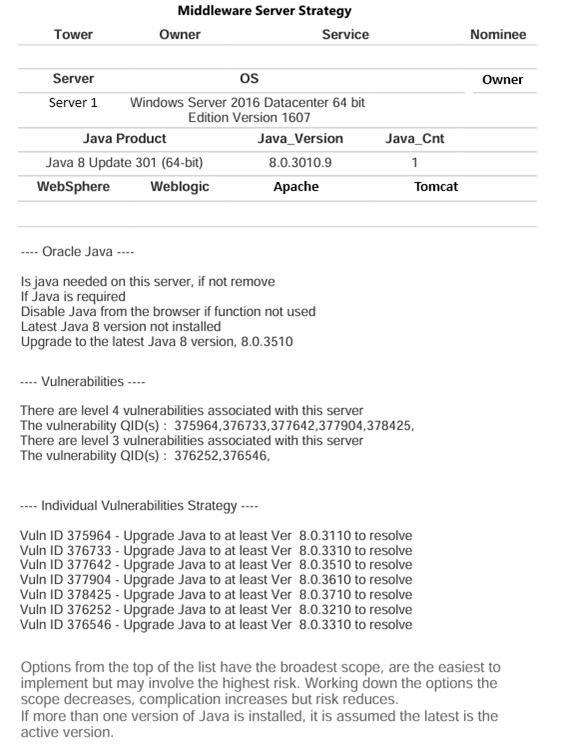
Fig 1 Server Strategy
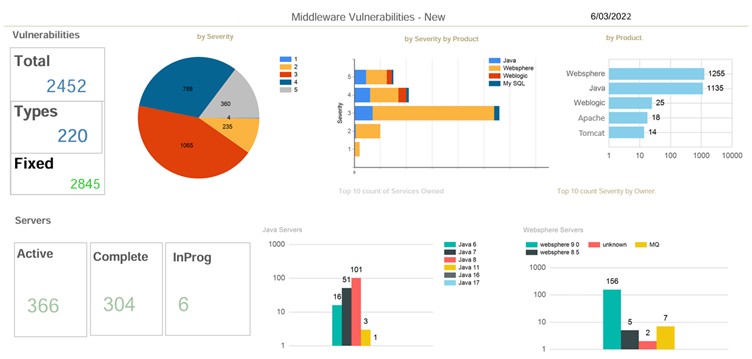
Fig 2 Customisable Dashboard